

Most people picture couples therapy as something you reach for once things have already gone wrong: constant arguments, an affair on the table, someone quietly looking at flats. If nothing that dramatic is happening in your relationship, it can feel like therapy isn't really meant for you.
But plenty of couples who eventually book a first session aren't in crisis at all. They're more likely to be sitting with a quieter, harder question: we're not falling apart, so is this actually for us?
That question deserves a real answer, not a sales pitch. This article looks at what couples therapy can offer outside of crisis, why so many couples wait far longer than they need to, and where the line sits between therapy, relationship education, and the kind of intimacy-focused coaching Coming Closer offers.
Couples Therapy Isn't Only for Relationships in Crisis
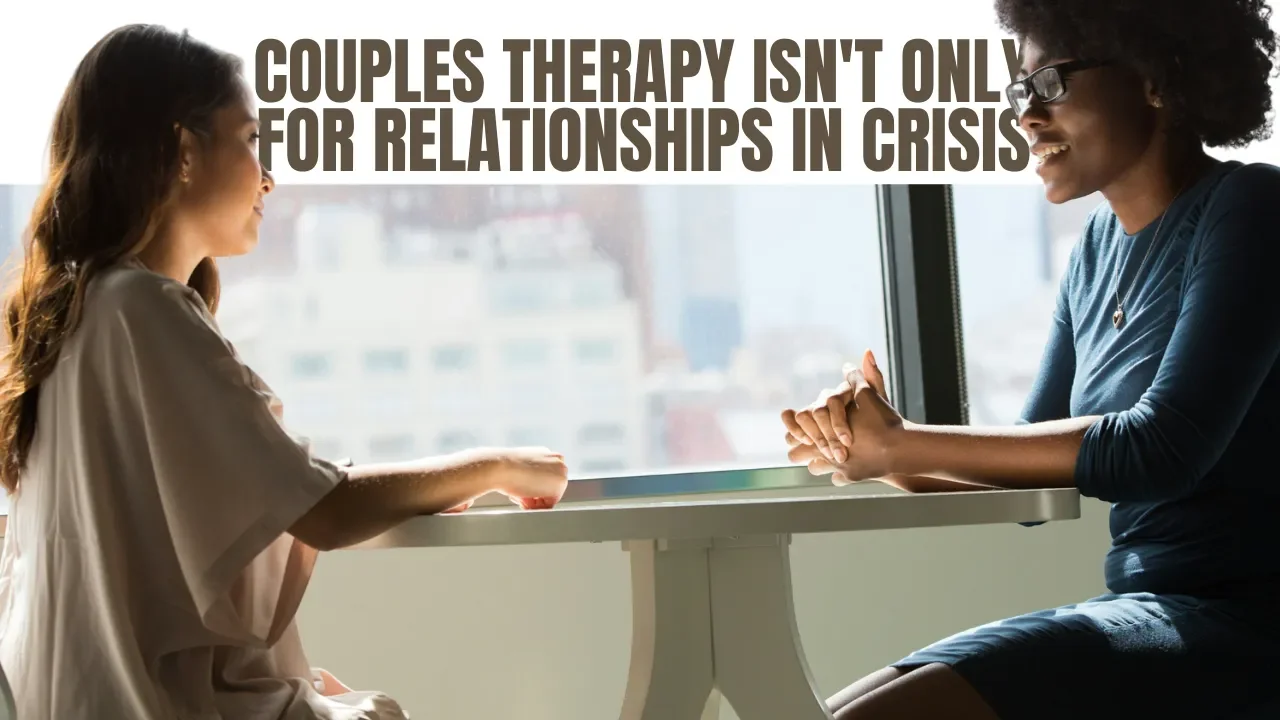
Relationship support exists on a spectrum, not a single point marked “emergency.” At one end is treatment: working through active distress, betrayal, or a relationship that feels close to ending. At the other end is prevention and maintenance: couples who are doing reasonably well and want to keep it that way, understand a recurring pattern, or grow closer on purpose rather than by accident.
The APA Dictionary of Psychology defines couples therapy simply as a form of psychotherapy in which both partners work with a therapist to improve their relationship. Nothing in that definition requires a relationship to be in danger first. In the UK, Relate, the country's largest relationship counselling provider, says directly that its service is there “even if your problems seem trivial, or even if you don't have problems at all.” The British Association for Counselling and Psychotherapy makes a similar point: for some people, counselling is a way to prevent relationship issues from growing in the first place, not just a response once they already have.
Somewhere between treatment and prevention sits enrichment: couples who love each other, function well, and still want more depth, more ease, or more honest conversation than they currently have. None of these categories are mutually exclusive, and a couple can move between them over the years. But it's worth naming the difference, because most of the public conversation about therapy only ever describes the treatment end.
What “We're Fine” Can Actually Hide
“We're fine” is doing a lot of work in a lot of relationships. It can mean the relationship genuinely is fine. It can also mean nobody has said out loud what's actually happening underneath.
Some of the quieter patterns that hide behind “fine” include:
Feeling more like co-managers of a household than partners
A slow drop in curiosity about each other's inner lives
Recurring, low-grade tension that never quite becomes an argument
Less physical affection, without either person deciding that on purpose
Sex that has become infrequent, or a topic neither of you brings up
Difficulty raising anything sensitive without one of you shutting down
None of this means something is wrong with you or your relationship. Long relationships naturally move through periods of closeness and distance, and a quieter stretch isn't automatically a warning sign. The distinction that actually matters is whether a pattern is something you're both aware of and choosing, or something that's been running on autopilot for so long that neither of you remembers deciding it.
Why Couples Wait Until Things Get Bad
If relationship support can genuinely help before things go wrong, why do so many couples wait until they don't?
Part of it is simple stigma. Booking a couples therapist can still feel like an admission that something is broken, even to people who wouldn't judge a friend for doing the exact same thing. Part of it is comparison: it's easy to look at a friend's divorce or a colleague's blow-up argument and quietly conclude that your own situation “isn't that bad,” as though therapy has a minimum entry requirement.
There's also a more private fear underneath both of those: that naming a problem out loud will make it more real than leaving it unspoken. Many people would rather live with a low hum of disconnection than risk a conversation that confirms it's actually there. And for couples who are otherwise doing well in every visible area of life, career, friendships, family, there can be a particular kind of confusion in admitting that the one area they haven't figured out is the relationship itself.
None of these reasons are irrational. They're just costly. The couples who wait until a crisis to get help are often trying to solve, in a handful of sessions under enormous pressure, a pattern that had been quietly building for years.
How Couples Therapy Can Help Before a Crisis

When a couple comes in before things have deteriorated badly, the work tends to look different from crisis intervention. There's more room to actually understand a pattern rather than just stop the bleeding.
Emotionally Focused Therapy, developed by psychologist Sue Johnson and grounded in attachment theory, is one of the more widely researched approaches here. It works from the idea that a lot of conflict isn't really about the stated topic (the dishes, the calendar, the in-laws) but about deeper questions of whether each partner can count on the other for comfort and connection. A couple that isn't in crisis can use this kind of work to understand their own conflict cycle clearly, long before it hardens into something harder to shift.
Other couples benefit from a more skills-based approach: learning to raise a concern without it turning into blame, noticing the moment a conversation is about to escalate, or practising the kind of active listening that sounds simple and is genuinely difficult under pressure. None of this requires a relationship to be in trouble first. It requires two people willing to look honestly at how they actually communicate, rather than how they assume they communicate.
Relationship Maintenance Is a Real Concept, Not a Marketing Line
“Preventive relationship care” can sound like something invented to sell more sessions. The research says otherwise, though it's worth being honest about how mixed that research is.
A review of 143 evaluations of marriage and relationship education programmes found modest evidence that these programmes help both distressed and well-functioning couples, with well-functioning couples showing benefits that appeared later, at longer-term follow-up, rather than immediately. A separate meta-analysis of premarital prevention programmes found that couples who took part generally showed measurable short-term gains in communication and relationship quality compared with couples who didn't. The honest caveat is that long-term effects are harder to demonstrate, and some later, larger trials have produced smaller or mixed results. Prevention work isn't a guarantee. It's a reasonable bet with real, if modest, evidence behind it, not a fix that lasts forever after a handful of sessions.
One practical version of this idea is the relationship checkup: a structured assessment, rather than open-ended conversation, designed to surface a relationship's strengths and vulnerabilities before either partner is in distress. The Gottman Institute's Relationship Checkup, built by researchers John and Julie Gottman from decades of observational research on couples, is one well-known example. It gives both partners a structured picture of what's working and what needs attention, which can be a useful starting point whether or not a couple goes on to do ongoing therapy.
Understanding the Pattern, Not Picking a Villain

One thing that surprises a lot of people who haven't been to couples therapy: a good therapist isn't there to work out who's right. Most recurring arguments aren't really about who's correct on the specific issue. They're about a pattern that has taken over, where one partner pushes for more contact and one partner pulls back for space, and the more one happens, the more the other does too.
This pattern shows up so often in the research that it has its own name: the demand-withdraw or pursue-withdraw cycle. Once a couple can actually see it (rather than just living inside it), the conversation shifts. It stops being “you always shut down” versus “you always attack,” and starts being “here's the cycle we both keep landing in, and here's how we get out of it together.” That reframe alone, understanding the pattern rather than assigning blame, is one of the more consistent things structured couples work offers, whether or not the relationship was ever close to crisis.
What About Intimacy and Sex?

A couple can genuinely love each other and still find that sex has quietly become complicated. Desire differences, less physical affection, difficulty bringing up anything sexual without it turning awkward: none of this necessarily means anything is broken. It's common enough that researchers have a specific term for it.
Sexual desire discrepancy, a mismatch between partners in how often or how intensely they want sex, is one of the most frequently reported concerns among long-term couples. A 2024 qualitative study published in Family Process found that desire discrepancy tends to shift and resurface repeatedly across the life of a relationship, shaped by changes in barriers, frequency, and how couples cope with the gap, rather than being a single problem to be permanently solved. The European Society for Sexual Medicine's position statement on the subject makes a related point: because sexual desire naturally fluctuates for both partners, a discrepancy on its own isn't automatically a dysfunction, though it can become distressing depending on how a couple relates to it.
None of this needs to stay walled off from the rest of a relationship. Emotional closeness and physical closeness tend to move together more than people expect: couples who feel disconnected outside the bedroom often find that shows up inside it too, and the reverse is also true. Working on emotional intimacy can shift the sexual side of a relationship, and working on sexual connection can shift how safe two people feel talking about everything else.
Where Somatic and Experiential Work Fits

Traditional couples therapy is largely a talking process: two people, a therapist, a conversation about patterns, history, and communication. That's genuinely useful, and for many couples it's exactly what's needed. But talk-based work has a real limit: understanding a pattern intellectually doesn't always change what happens in your body in the actual moment it counts.
This is where somatic and experiential approaches to intimacy differ. Rather than only discussing a pattern, this kind of coaching works with the body directly: presence, breath, touch, pacing, and how the nervous system responds under closeness or pressure. It's worth being precise here: this is coaching, not psychotherapy, and it isn't a replacement for clinical treatment of trauma or mental health conditions. What it offers instead is a practical, experiential way to build the skills that talking about intimacy doesn't automatically produce on its own, things like staying present during physical closeness, or communicating a need in the actual moment rather than analysing it afterwards.
Andre Lazarus works with individuals and couples through this kind of somatic, body-based approach to intimacy coaching, often alongside or after more traditional talk therapy rather than instead of it. For couples based in or visiting the UK, he offers in-person and online sex and intimacy coaching specifically for people who've already done the thinking and are looking for a more embodied way to close the gap between insight and actual change.
Signs You Might Benefit From Support, Even If You're Not in Crisis

Some of the couples who benefit most from relationship support aren't in obvious trouble. A few patterns worth paying attention to:
If you're struggling:
The same argument keeps resurfacing in slightly different clothes
One or both of you shuts down rather than engages during conflict
Trust has been damaged and hasn't fully been repaired
You're functioning well as co-parents or housemates, but not as partners
If you're actually doing pretty well, but want more:
You're curious what deeper emotional or sexual connection would even look like for you
You want a structured way to talk about a life transition before it becomes a source of tension
You want a neutral space to check in on the relationship, the way you'd get an annual health check rather than only seeing a doctor when something's wrong
You've noticed a pattern (pursuing, withdrawing, over-functioning) and want to understand it before it calcifies
The second list matters as much as the first. A relationship doesn't need visible problems to be worth paying attention to.
When Couples Therapy May Not Be the Right Starting Point
Couples therapy assumes two people working together on a shared relationship. That assumption doesn't hold in every situation, and it's worth naming clearly rather than glossing over.
Where there is intimate partner violence or coercive control, standard couples therapy is generally not appropriate and can make an unsafe situation more dangerous, since it treats both partners as equally responsible for a dynamic that isn't actually mutual. Mental health professionals typically recommend individual safety planning and specialist support instead in these situations, at least until safety has been established. If this describes your relationship, that's the more urgent starting point, not this article.
Outside of that specific situation, most of the hesitations people have (embarrassment, not knowing what to say, worrying it will make things worse before it gets better) tend to ease once the first conversation actually starts.
You Don't Have to Wait Until You're on the Brink

None of this means every couple needs therapy, or that therapy guarantees a better relationship, or that avoiding it means something is wrong with you. It means the window for getting support is wider than most people assume, and the version of you that waits for a crisis isn't more deserving of help than the version of you paying attention right now.
Sometimes the healthiest moment to look closely at a relationship is while there's still curiosity in it, while there's still goodwill, while the two of you still actually want to understand each other rather than just get through the week. That's not a lesser reason to seek support. It might be the better one.
If part of what you're noticing is around intimacy, sexual connection, or the gap between what you understand and what actually happens between you, that's a specific and common enough experience that it's worth exploring what slow, mindful intimacy practices can look like in practice.
Frequently Asked Questions

Can couples therapy help if we're not having serious problems?
Yes. Couples therapy is often associated with crisis, but relationship support also includes prevention, maintenance, and enrichment. Couples who aren't in serious distress commonly use it to improve communication, understand a recurring pattern, or deepen connection on purpose.
Is couples therapy only for couples considering divorce?
No. While many couples do seek therapy during a serious crisis, plenty of others use it proactively, before a life transition, after noticing a pattern, or simply because they want a more intentional relationship. There's no minimum severity requirement to benefit from it.
What is preventive or maintenance-focused couples therapy?
It's relationship support used before serious distress develops, rather than in response to it. This can include structured communication skills work, a relationship checkup or assessment, or ongoing sessions aimed at keeping a functioning relationship healthy rather than repairing a damaged one.
What is a relationship checkup?
A relationship checkup is a structured assessment, distinct from open-ended talk therapy, that identifies a couple's strengths and vulnerabilities across areas like communication, intimacy, and conflict. The Gottman Institute's version is one widely used example, often used as a starting point before or alongside ongoing therapy.
Can couples therapy help with intimacy and sex?
Yes, within scope. Couples therapists can address communication about sex, desire differences, and how emotional and physical intimacy interact. For more experiential, body-based work on sexual connection specifically, some couples also work with a somatic intimacy coach alongside or after talk-based therapy.
What's the difference between couples therapy and relationship or intimacy coaching?
Couples therapy is a form of psychotherapy, typically delivered by a licensed clinician, and can address clinical concerns like trauma or mental health conditions. Coaching, including somatic intimacy coaching, is not psychotherapy. It's typically more goal-oriented and experiential, focused on building specific skills and embodied awareness rather than treating a diagnosis.
Conclusion
The idea that couples therapy is only for relationships on the edge keeps a lot of people from getting useful support at the exact point it would help most. Relationship care exists on a spectrum, and treatment is only one part of it. Prevention, maintenance, and enrichment are real, evidenced approaches too, not a lesser or invented category. You don't need a crisis to justify paying attention to your relationship. Sometimes the best time to do it is simply now, while there's still something good worth building on.
